
【Paper Published】Facial Expressions Reveal Brain Fatigue During Intense Exercise
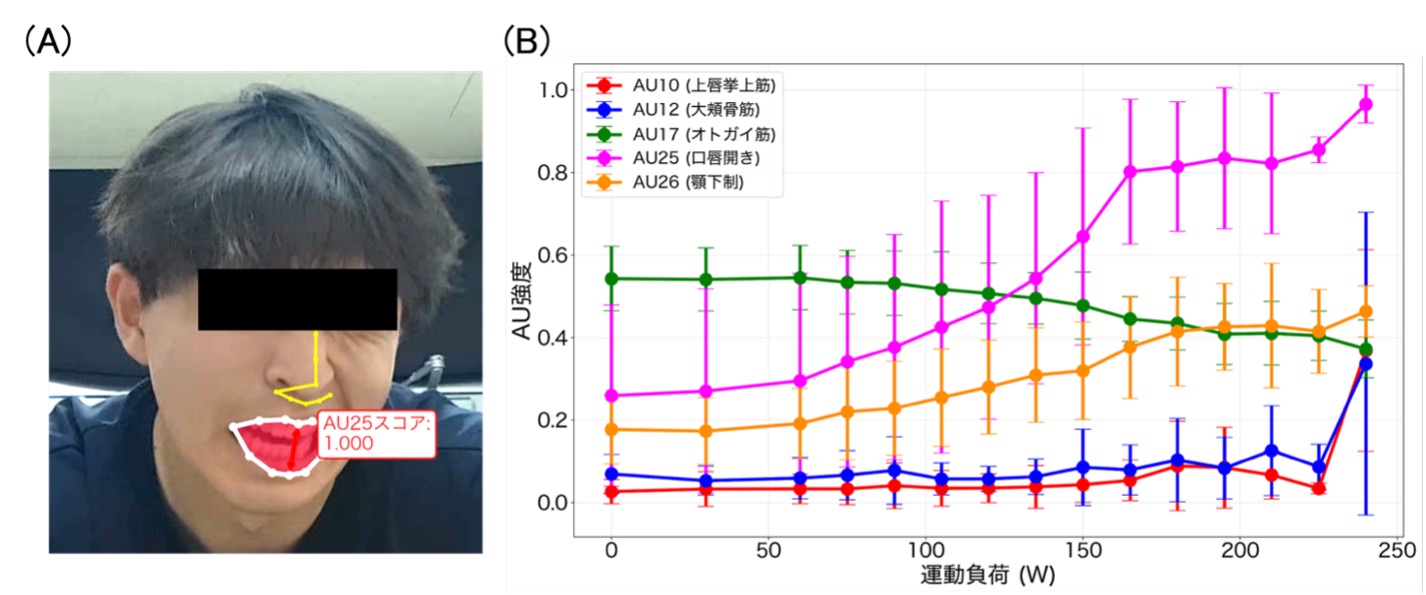
Objective Assessment of Brain Fatigue During Intense Exercise Through Facial Expression Changes
Research Summary
A research group led by Lecturer Genta Ochi, Tomoya Koyama (4th-year undergraduate student), and Keita Koneyama (1st-year master's student) from the Department of Health and Sports at Niigata University of Health and Welfare focused on facial expression changes when exercise intensity increases from moderate to high intensity. Their findings revealed that individuals showing greater mouth movements (AU25: lip opening) experienced more pronounced decreases in psychological arousal (related to concentration and attention).
This research suggests that facial expression analysis could serve as a novel, non-invasive indicator for real-time assessment of brain fatigue during exercise. The findings were published on October 27, 2025, in the international sports science journal "Journal of Sports Sciences."
Research Background
Have you ever heard commentary during a marathon broadcast stating, "The athlete's mouth is opening wider—fatigue is evident"? This facial expression change may hold important significance.
For athletes, maintaining concentration and decision-making abilities (executive function) during exercise is essential for performance enhancement and injury prevention. Intense exercise causes not only physical fatigue but also "brain fatigue," which is known to impair executive function.
The phenomenon of mouth opening during exercise may be a sign of this brain fatigue. However, no simple method has been established to assess brain fatigue during exercise in real-time.
Research Methods
This study tested 25 healthy male university students using a cycle ergometer with incremental exercise intensity.
Measurements:
- Facial Expression Analysis: Facial expressions during exercise were recorded on video and automatically analyzed using the Python Facial Expression Analysis Toolbox (Py-Feat) to quantify 16 types of AUs (Action Units: facial movements)
- Physiological Indicators: Heart rate, blood lactate concentration, and rate of perceived exertion (RPE) were measured
- Psychological Indicators: Arousal level (concentration and attention) was assessed using the Two-Dimensional Mood Scale (TDMS)
Key Research Findings
- Relationship Between Facial Expressions and Physiological Indicators: AU10 (upper lip raiser), AU17 (chin raiser), AU25 (lips part), and AU26 (jaw drop) were associated with exercise intensity, heart rate, blood lactate concentration, and RPE (r = 0.314-0.631, all P < 0.05). Lower facial region (mouth area) changes were particularly prominent.
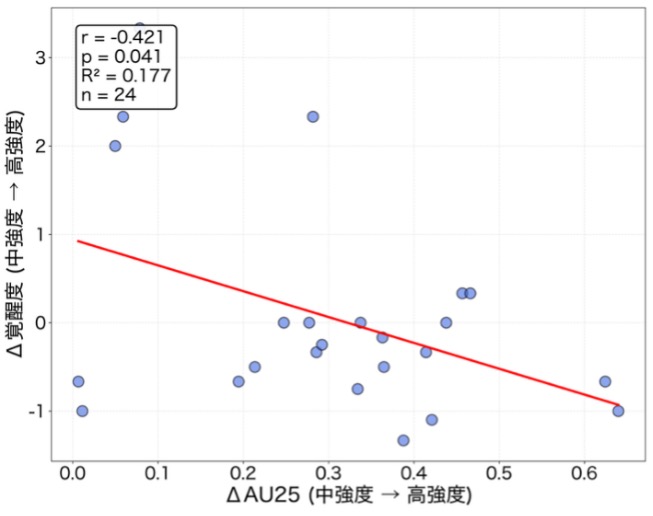
- Relationship Between AU25 and Psychological Arousal: During the transition from moderate to high-intensity exercise, individuals with greater AU25 (lip opening) changes showed more pronounced decreases in concentration and attention (r = -0.421, P < 0.05). This discovery demonstrates that facial expression analysis can be utilized as a new non-invasive method for monitoring "brain fatigue" during exercise.
Research Highlights
- Cognitive fatigue during intense exercise is a critical issue that increases the risk of performance decline and judgment errors leading to injuries
- The study demonstrated that facial image analysis enables non-invasive monitoring of psychological and physiological responses during exercise
- AU25 (lip opening) changes serve as a reliable indicator for predicting psychological arousal decline (decreased concentration and attention) during intense exercise
- This method can be integrated with existing cameras and facial recognition devices, contributing to athlete training load management and the design of exercise programs that optimize cognitive function
Research Significance and Future Directions
This study established an innovative method for assessing brain fatigue during exercise non-invasively and in real-time. Using facial expression analysis technology, it is possible to objectively capture decreases in concentration and attention without burdening athletes.
Future developments include incorporating this technology into wearable devices and smartphone applications for practical use in athletic training settings. Applications in rehabilitation and exercise guidance for elderly individuals are also envisioned.
Research Information
Paper Title: Facial Lower-Region Changes During High-Intensity Exercise as Predictors of Reduced Arousal State
Authors: Genta Ochi¹²*†, Tomoya Koyama¹, Keita Oneyama³, Yumi Okamoto¹², Tomomi Fujimoto¹², Daisuke Sato⁴⁵, Koya Yamashiro¹²
(*First author, †Corresponding author)
Affiliations:
- Department of Health and Sports Science, Faculty of Health Sciences, Niigata University of Health and Welfare
- Institute for Human Movement and Medical Sciences, Niigata University of Health and Welfare
- Graduate School of Health Sciences, Division of Health and Sports Science, Niigata University of Health and Welfare
- Faculty of Health and Sport Sciences, University of Tsukuba
- Advanced Research Initiative for Human High Performance (ARIHHP), University of Tsukuba
Journal: Journal of Sports Sciences
DOI: https://doi.org/10.1080/02640414.2025.2574109
Research Funding:
- Niigata University of Health and Welfare Research Incentive Grant 2024 (Principal Investigator: Genta Ochi)
- Casio Science Promotion Foundation 42nd Research Grant (Principal Investigator: Genta Ochi)